

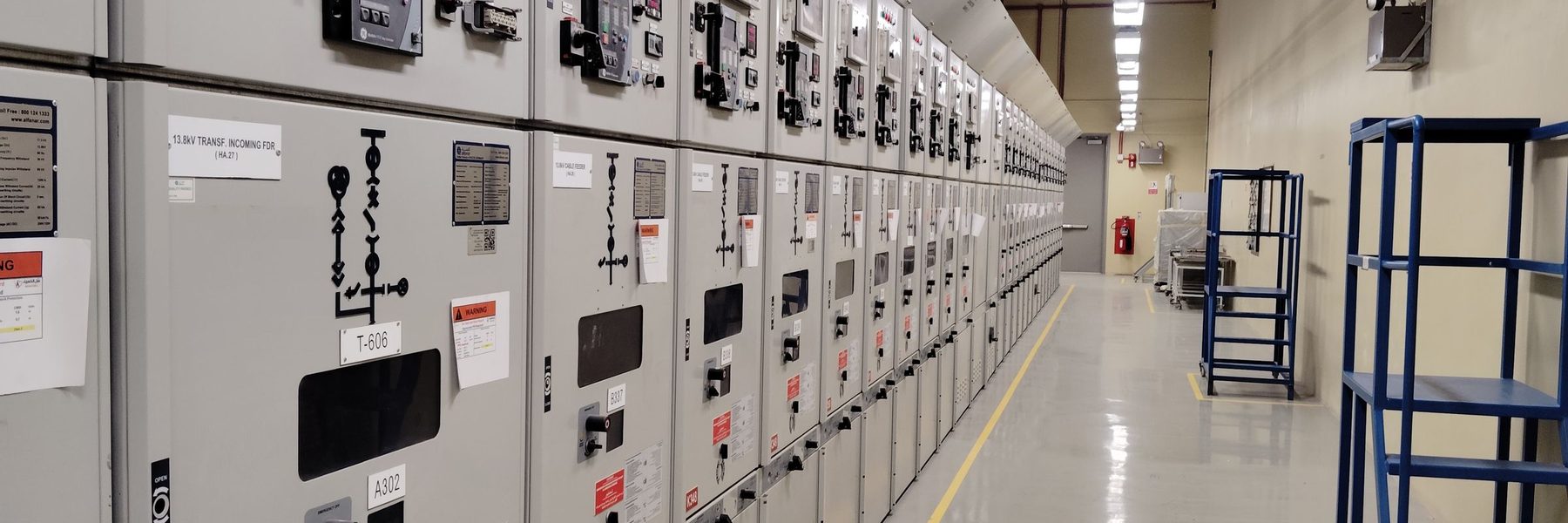
Electrical Engineering
Reliable electrical infrastructure is the spine of every building we design. From utility service to the last device, we engineer normal, standby, and emergency power systems that meet today's load and tomorrow's growth, backed by short-circuit, coordination, and arc-flash analyses that survive the field.
Today's buildings carry more electrical and electronic load than ever, EV charging, solar interconnection, and battery storage on infrastructure that was never sized for them. Our engineers work with national and local electric codes daily and design for the load that is coming, not just the load that exists.
Our Approach

How We Work
We start at the utility and work inward: service capacity, fault current, selective coordination, and resiliency topology are settled before panel schedules begin. The result is a distribution system that passes review the first time and grows without rework.
- Short-circuit, coordination & arc-flash studies in-house
- Topologies matched to criticality, N+1 to 2(N+1)
- Utility coordination & interconnection filings handled
Service Capabilities
A.Power Distribution
- Service entrance & utility coordination
- Medium-voltage distribution design
- Low-voltage distribution design
- Switchgear, switchboard & panelboard design
- Branch circuit design & device layout
- Motor control center (MCC) design
- Variable frequency drive (VFD) integration
- Cable tray & raceway systems
- Substation design (indoor & outdoor)
- Specialty & equipment power
B.Backup & Critical Power
- Normal, standby & emergency power distribution
- Generator, ATS & UPS systems
- Battery energy storage (BESS) integration
- Microgrid & islanding design
- Cogeneration & CHP interconnection
- Healthcare electrical (NFPA 99, isolated power)
- Mission-critical / data center power (Tier I–IV)
- 2N, N+1 & 2(N+1) topology design
C.Renewables & Site Power
- Solar PV interconnection & on-site renewables
- EV charging infrastructure (Level 2 / DCFC)
- Site & campus distribution
- Photovoltaic + storage integrated systems
- Net-metering & utility interconnection filings
D.Studies, Protection & Assessments
- Short-circuit & coordination studies
- Arc-flash hazard analysis (NFPA 70E)
- Selective coordination (NEC 700/701/708)
- Fault current studies
- Protective relaying for medium-voltage systems
- Grounding, bonding & lightning protection
- Power quality & harmonic analysis
- Power factor correction & capacitor banks
- Power monitoring & submetering
- IR thermography & predictive maintenance
- Existing electrical assessments & upgrades
- 3D laser scanning of existing electrical rooms & distribution
- Electrical infrastructure master planning
- Forensic electrical engineering
Why Owners Choose KeRi
Reliability by Design
Redundancy topology is matched to what the building actually does, healthcare, data, or housing, not a one-size template.
Studies That Survive
Our short-circuit, coordination, and arc-flash studies are engineered to field conditions so the labels match reality.
Future-Proof Capacity
EV charging, solar PV, and battery storage headroom is designed in from day one, not value-engineered in later.